What Cornell Knew and What the Prosecutor Never Saw
Jane Doe told Cornell she was raped at Chi Phi, sought medical care, preserved evidence, reported to police and sat through hours of questioning. Two years later, the prosecutor says the full interview in which she described rape, coercion and incapacity was never placed in front of him.
I want to start with Jane Doe, not with Cornell’s public statements, the lawsuit or the people who later picked through her life online. In November 2024, she sat for a two-day interview with Cornell University Police and said, “I can say with 100% confidence I was raped.” [1] Her civil complaint later named seven former Chi Phi members and identified four as the men who raped her. [3] Cornell heard her account directly, with its police investigator, Title IX investigator, advocate and adviser in the room long before this became a national story.
Her two-day police interview ran roughly 120 pages, an enormous amount of detail compared with the six-page statement prosecutors reviewed. Van Houten says he did not receive the full interview before his office declined charges and that prosecutors instead reviewed the shorter statement and Snapchat material. [1][15] Cornell described the transfer differently, saying CUPD sent a lengthy investigative report. Its FAQ initially told the public that police had shared “all investigatory information.” Cornell later removed those words and replaced them with a narrower description. [2][16] Jane Doe spent hours telling Cornell police what happened to her, and the prosecutor who made the charging decision says the fullest version of that account was never in front of him.
JANE DOE SAID IT BEFORE THE LAWSUIT
Jane Doe’s first messages are uneven, and I am not going to treat that as a character flaw. She was trying to piece together a night she did not fully remember while people around her were already talking about what had happened. [3][4] Her roommates later remembered distress, confusion and uncertainty, and those early reactions have been pulled apart publicly as a test of whether she deserved to be believed. The same early record also contains bruising photographs, a preserved dress, medical care, a forensic examination, a police report and later statements that what happened was not consensual. I do not need her first texts to read like testimony written months later, and neither does the chronology.
By November 3, before the lawsuit and before the national coverage, Jane Doe was already telling one of the men, “Let’s be clear that 90% of what happened that night was not consensual.” [4][40] Days earlier, one of the men had apologized for “how things went down.” He wrote that he and another fraternity brother had been too intoxicated to “shut it down and kick people out before it got way out of hand.” [4] Jane Doe went to Cornell Health, preserved the dress she had worn and photographs of bruising, requested a sexual assault forensic examination and reported to CUPD. [4][6][7] She then sat through the police interview in which she said she was completely certain she had been raped. All of that was happening in 2024, while she was still trying to understand the night and long before the civil complaint turned the case into national news.
THE NIGHT BECAME A FRATERNITY EVENT
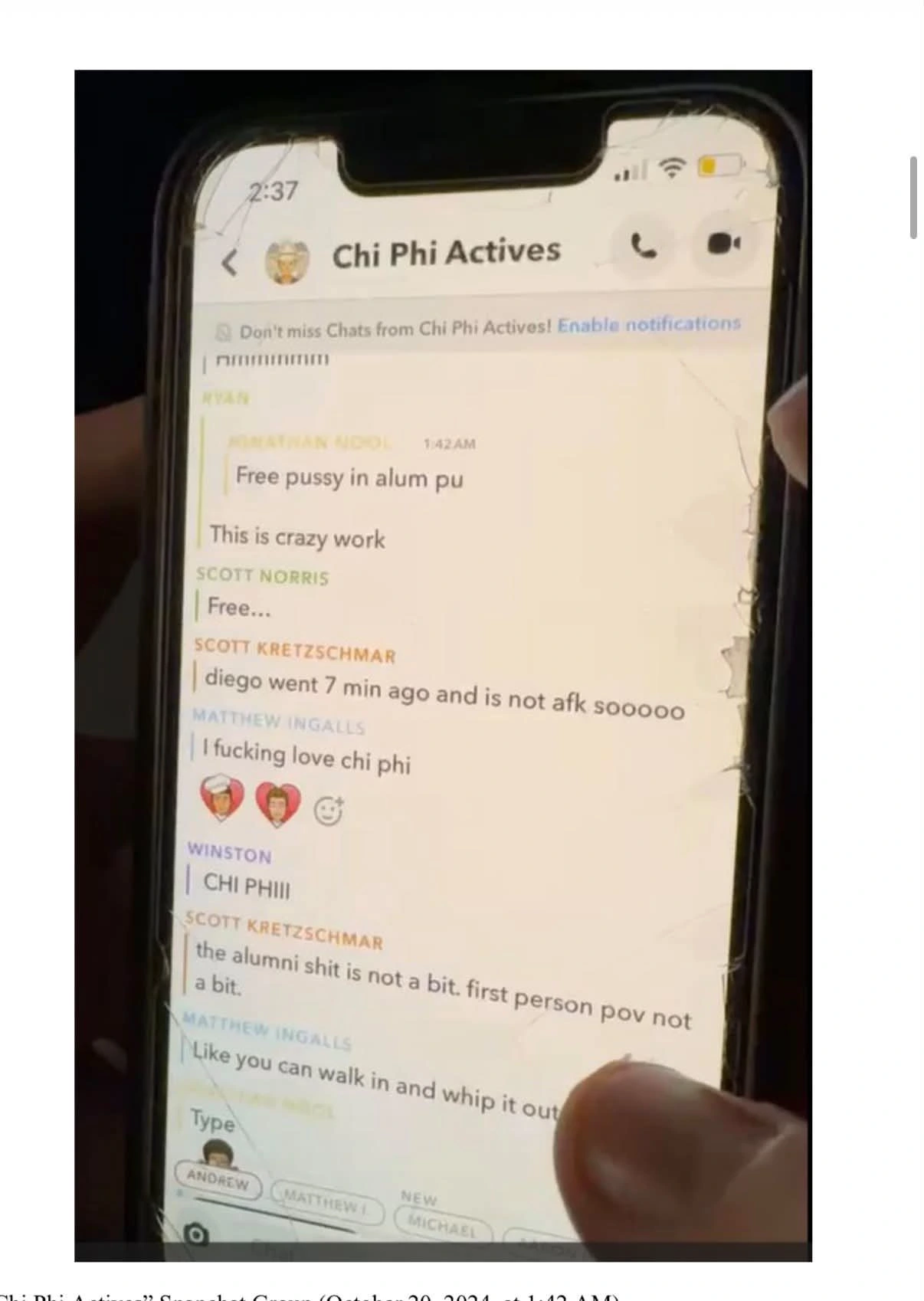
While Jane Doe says she was losing control of what was happening inside the room, Chi Phi’s own communications were carrying updates about her outward. The filed complaint reproduces messages from a Snapchat group called “Chi Phi Actives.” One post advertised sexual access to her as “free pussy” upstairs. Her photograph was circulated into the thread, men were invited to enter and a later exchange asked whether the “shop” was still open. [8][40] CBS reported that one participant told Cornell investigators about 50 fraternity members were on that thread, while ABC described the audience as more than 50 fraternity brothers. [14][40] The next morning, a sorority member told Cornell investigators that one of the men called and asked her to make sure another student did not “say anything that she thinks might’ve happened last night.” CBS reported that he first denied the call and later acknowledged a conversation about not spreading rumors. [9] The same interview record includes the phrase “just deny.” A student also told investigators she gave CUPD a written witness statement about that contact, and the 565-page material obtained by CBS did not explain what became of it. [9]
The civil complaint names seven men, but Cornell had a much larger fraternity around them to question. Cornell’s Fall 2024 grades report lists 57 Chi Phi members. CBS and ABC place roughly 50 to more than 50 fraternity brothers on the specific Snapchat thread. [31][14][40] Those are different records, but both point to a large circle of people who could have had relevant knowledge about the house, the chat or the events surrounding Jane Doe that night. Cornell had the roster, the chapter structure, the house and the authority to ask every active member what he saw, what he received, what he opened, what he replied to and what he did next. No member with relevant knowledge should have been able to disappear into the anonymity of the group because only seven men later became defendants in the civil case.
The chapter itself belongs in this story because the conduct around Jane Doe was social before Cornell ever turned it into an administrative case. A woman was discussed in fraternity communications as something men could access. Her photograph was circulated, men were invited upstairs and the next-day record includes a request aimed at what another student might say. [8][9] Anyone shown to have participated, encouraged, facilitated, shared images, intimidated, retaliated or concealed information should have faced consequences matching that conduct. Expulsion and referral to law enforcement should have been available where the evidence supported them. A fraternity does not become irrelevant once a lawsuit names individual defendants, especially when the communications, the house and the people moving through it were all part of the same environment.
Jane Doe v. Cornell University, Inc., et al.
Filed civil complaint. The Chi Phi Actives material discussed above appears in the filing.
Filed September 2026 civil complaint.
CORNELL OWNED THE HOUSE
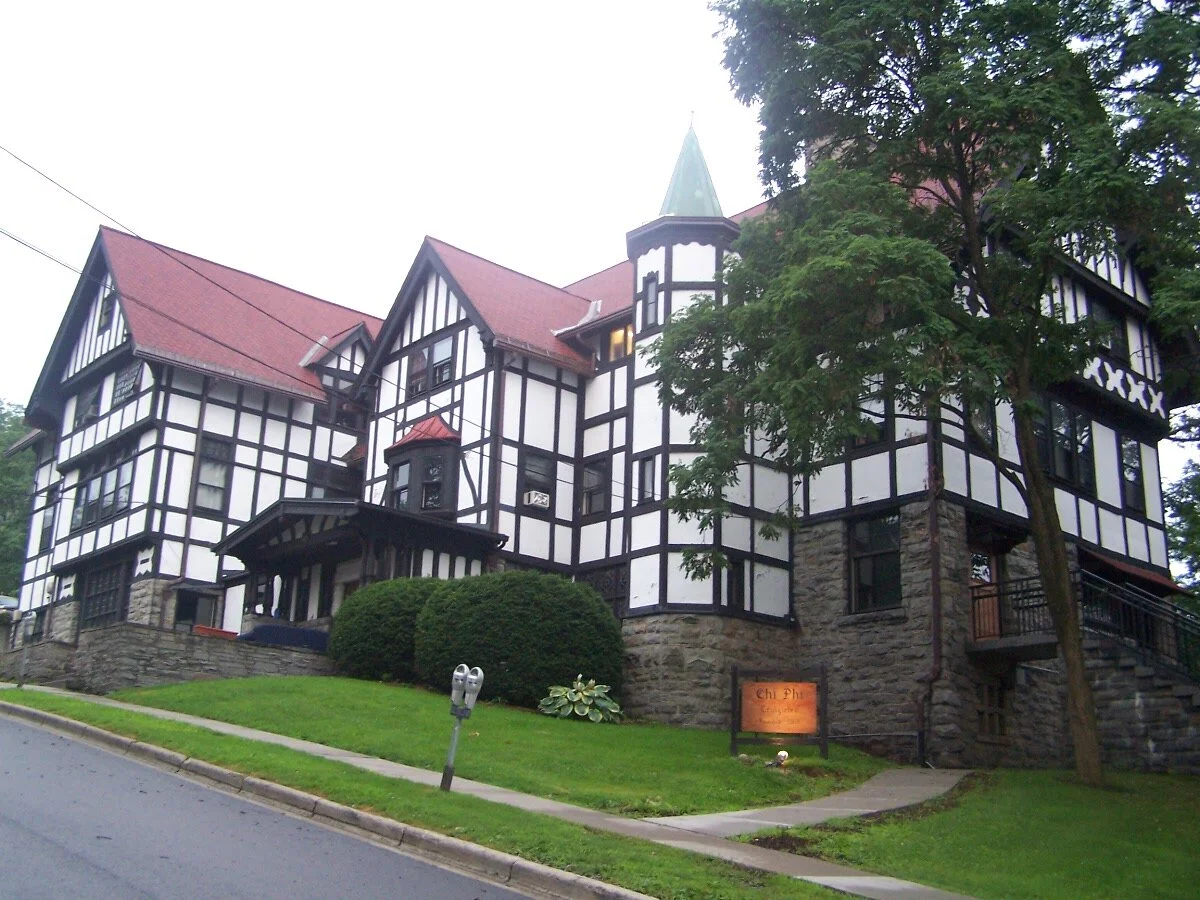
107 Edgemoor Lane was Cornell property, identified by Cornell Facilities as university-owned fraternity housing and designated Facility 4716. University records show Cornell personnel managing building-level work there before the night Jane Doe says she was raped. [10] Cornell recognized and regulated the chapter, ran the police department that received her report, ran the health service she visited, controlled the Title IX and disciplinary process and later closed the chapter. The national Chi Phi organization says implicated members were removed, while Cornell suspended the chapter after the November 8 report and ultimately barred it from campus. [11] Jane Doe walked into a fraternity house that Cornell owned and into an organization Cornell had chosen to recognize.
Cornell’s relationship to Chi Phi did not begin after Jane Doe reported rape. The university owned the house, recognized the organization, regulated fraternity life, operated the police force that took her report, operated the health service she visited and controlled the disciplinary system that later investigated the men. Those roles belonged to the same institution even though they were handled by different offices. Cornell later became the landlord explaining the house, the investigator explaining the evidence, the disciplinarian explaining the sanctions and the university explaining its own response. It was never an outsider looking in on a private organization with which it had no connection.
CORNELL HAD BEEN WARNED ABOUT GREEK LIFE LONG BEFORE HER
Cornell had already disciplined Chi Phi before Jane Doe ever entered 107 Edgemoor. The university’s organization scorecard records a 2018 hazing and hard-liquor case that brought probationary recognition and social probation. It records a 2020 event-management case involving overcrowding and insufficient sober monitors, followed by a 2023 misconduct finding and more corrective programming. [41] Cornell had also spent years trying to repair the broader Greek system after hazing deaths, abuse cases and other crises. A fraternity-wide social shutdown followed drugging and sexual-assault reports in 2022. The 2023 reopening came with consent training, bystander intervention, event checks and stronger sober-monitor rules. [32][35] Within days of Jane Doe’s 2024 police interview, The Cornell Daily Sun reported that around 100 fraternity leaders representing all 29 IFC chapters met for hours. They suspended social activity for the weekend and approved more sexual-assault-prevention training. [42] Cornell and its fraternity leaders had already been through years of warnings, sanctions and reform before Jane Doe ever sat down with police.
By October 2026, all 22 Cornell IFC fraternity presidents again voted to cancel social events for a weekend because of the public reckoning over Jane Doe’s case. [35] Cornell had already tried temporary shutdowns, consent education, bystander training, sober monitors, event checks, task forces and chapter discipline. The university still found itself back in emergency mode after another sexual-violence crisis tied to fraternity life. Another short suspension can interrupt a weekend, but it does not answer why the same system keeps requiring emergency intervention. Cornell has had years to decide whether preserving Greek life is worth the harm that keeps surfacing around it.
WHAT CORNELL POLICE HEARD FROM HER
On November 8, 2024, Cornell’s police log recorded Jane Doe’s report under CUPD case 24-28167. It classified the incident as “Assault, Sex Offense” in the 100 block of Edgemoor Lane. [12] ABC later reported that the first police report said, “A female undergraduate student reported that she was recently raped by 8-10 men at the Chi Phi fraternity house.” [40] The multi-person rape account was in the police documentation from the beginning. It did not first appear when the civil complaint became public in 2026. Cornell’s archived crime-log snapshots still showed the disposition as “Pending” in December, while a separate Crime Alert used a different occurrence date from the one in the log. Federal Clery guidance requires older portions of the crime log to remain available for public inspection, which is why those archived entries still allow the public to see what CUPD recorded in 2024. [13]
Six days after that report, Jane Doe sat for the first day of a police interview that continued into November 15. A CUPD investigator questioned her while a Cornell Title IX investigator, victim advocate and adviser were also present. [14] The transcript runs roughly 120 pages, while the written statement prepared from those hours of questioning is six pages. Jane Doe reviewed the shorter statement after the investigator read her account back and gave her opportunities to clarify or correct it. [14] The full transcript contains rape, coercion and incapacitation language that later reporting says did not appear with the same force in the material prosecutors reviewed. Van Houten has said those words would have prompted further inquiry. [15] Jane Doe reported, answered questions for hours, reviewed what police wrote, corrected it and signed it, and the prosecutor who later declined charges says he never received the full interview.
THE PROSECUTOR SAYS HE NEVER SAW THE FULL INTERVIEW
Van Houten says his office received Jane Doe’s six-page statement and “nothing more except for the Snapchat video.” Cornell told CNN that CUPD shared a “lengthy investigative report.” Its FAQ initially said “all investigatory information” had been shared with the DA, then Cornell removed those words and later identified the sworn statement and Snapchat screenshot as records that had been sent. [16] A separate student told investigators that she gave CUPD a written witness statement about the next-day contact. CBS reported that the 565-page Title IX material it obtained did not explain what happened to that statement. [9] By the time the public learned any of this, Cornell, CUPD and the district attorney were describing different collections of evidence from the same case. Jane Doe had already spent hours giving Cornell the fullest account she could.
Jane Doe gave Cornell police a full interview saying she had been raped. The prosecutor who decided not to charge anyone says he never received that interview, and Cornell later possessed it inside a much larger administrative process. [2][15] Cornell then changed the language on its public FAQ after questions emerged about what CUPD had actually sent. Van Houten later said his office had not been given the “full picture.” [2][27] New York removed his office from control of the criminal case and appointed the Attorney General as special prosecutor. [26][27] The gap between those records sat directly between Jane Doe’s hours of police questioning and the decision that no one would be criminally charged. She had already done the part the system demanded from her.
Tompkins County District Attorney public statement
Public statement dated September 28, 2026.
Tompkins County District Attorney public statement.
CORNELL LATER BUILT A RECORD BIGGER THAN THE ONE PROSECUTORS SAW
By early 2025, Cornell’s administrative process contained both the full police interview and the six-page statement prosecutors had reviewed, and the university’s evidence collection was still growing. CBS reported that Cornell’s process involved about 50 interviews with 32 witnesses. The 565-page transcript set it obtained included Jane Doe, six of the seven men later named in the civil suit and 20 witnesses. [14][18] The New York Times reviewed a broader production exceeding 1,000 pages, and AP described a 99-page hearing-panel report among later court records. The Washington Post also reported from unsealed material that Cornell’s inquiry involved more than 50 interviews with 32 witnesses. [18][43] The prosecutor says his original charging decision was made without the full police interview containing Jane Doe’s clearest descriptions of rape, coercion and incapacity. By the time Cornell had built hundreds and then thousands of pages around what she said happened inside Chi Phi, the criminal charging decision had already been made on a record the prosecutor himself now describes as incomplete.
Cornell’s disciplinary process produced expulsions, multi-semester suspensions and separate findings of Sexual Assault and Sexual Exploitation. [19][20] In Scott Kretzschmar’s case, Cornell rejected the Sexual Assault and completed Sexual Exploitation charges against him and found him responsible for Attempted Sexual Exploitation. [20] He challenged that finding, and a Tompkins County judge dismissed his petition on September 23, 2026. He filed a notice of appeal two days later. [22] His result is one part of a respondent-by-respondent process that also produced much more serious sanctions and findings against others. By then Cornell had spent months interviewing dozens of people and deciding individual cases from a record far larger than the one the prosecutor says he reviewed before declining charges.
Kretzschmar Article 78 record
Court record tied to the respondent-specific disciplinary challenge discussed above.
Respondent-specific court record.
THE CONSEQUENCES STILL DID NOT MATCH WHAT JANE DOE LOST
Jane Doe wanted out, and her lawyer says she asked Cornell to return her tuition after the incident because she wanted to leave. Cornell refused that request, leaving her in an environment where she could encounter men she had accused. [39] She later dropped out, while public reporting describes the continuing emotional toll the case has taken on her. [4][39] Cornell processed men through hearings, imposed sanctions, closed Chi Phi and eventually created another task force. Jane Doe was the person whose education, safety and connection to Cornell were broken apart. She went to Cornell as a student and ended up fighting the university, the criminal process and the internet to keep control over her own story.
Cornell should give Jane Doe back every dollar she paid for the period in which she was trying to survive the aftermath of what happened at Chi Phi. It should also fund the support she needs without making her fight for each form of relief. She asked to leave, Cornell refused the tuition refund, and she later dropped out. [39] The university found the time and money to investigate, hold hearings, litigate respondent challenges, commission a task force, issue public statements and agree to an outside review. It can decide that the woman who reported being raped in a Cornell-owned fraternity house should not be the person left paying financially for the semester that changed her life.
THEN THE INTERNET MADE HER THE TARGET
Then the case exploded nationally and strangers began trying to take away the one thing Jane Doe had still kept for herself: her name. Michael Tracey publicly asked people to send him identifying information. He later published what he said was her identity, removed it and still defended the decision to identify her. [36] Aidan Thompson and AF Post separately claimed to have identified Jane Doe and attributed the claim to Cornell students. Their public posts did not provide a source chain readers could independently verify. [37] Women responded with the #IAmJaneDoe movement after watching a rape complainant’s anonymity become a prize for strangers to hunt. [36] Jane Doe had already spent two years explaining what happened to police, investigators and university officials, and now the internet wanted her to defend her right to remain anonymous too.
The online attacks kept returning to the same handful of ideas: an early text, continued contact, uncertainty, delay and the fact that Jane Doe did not react in the exact way strangers expected. By November 3, she had already told one of the men that 90 percent of the night was not consensual. She sought a forensic examination and made a police report soon afterward. She later told CUPD she was completely certain she had been raped. [4][40] People still put her behavior under a microscope while giving far less attention to the men moving through the room, the fraternity chat discussing access to her, the next-day request about what another student might say, the records Cornell held or the interview the prosecutor says he never received. I do not want to replace one “perfect victim” script with another. Jane Doe’s record belongs to Jane Doe, and no one survivor’s response should become a template used to judge another. If you are reading this with your own history in mind, the lesson is not that survivors must report faster, remember more clearly, preserve more evidence or react the way she did.
CORNELL’S OWN NUMBERS MAKE THE SYSTEMIC PROBLEM IMPOSSIBLE TO IGNORE
Cornell’s 2025 survey and 2026 Presidential Task Force report describe a campus problem much larger than one closed fraternity. Thirty-five percent of responding undergraduate women reported sexual assault during their Cornell career, up from 23 percent in 2023. Among responding Greek-affiliated undergraduate women, the figure was 52 percent. Among responding undergraduate women who were not Greek-affiliated, it was 29 percent. [33] Fraternity chapter houses accounted for 17 percent of the identified locations in the survey data, and Cornell cautioned that the undergraduate response rate was only 13 percent. [33] The same report found that only about a third of Ithaca students knew about the confidential SHARE Office or Victim Advocacy Program. Fewer than half knew where to find the SHARE website. Only a quarter knew how to file a formal complaint or what happened after one was filed. [33] Cornell’s task force responded by recommending annual in-person consent and sexual-citizenship training for fraternity and sorority members and additional situation-based training for Greek leaders. [33] The university had spent years announcing Greek-life reforms while many students were still reporting sexual violence and many still did not know how to navigate the systems meant to help them afterward.
Cornell’s students were asking for more than another statement about university values. Reuters reported students at the October 2026 public hearing describing fear, anger and their own experiences of sexual assault. The Student Assembly unanimously approved a resolution demanding a full account of the Jane Doe case and annual reporting on future misconduct outcomes. [34] Twenty student organizations then announced a Justice for Survivors protest demanding an external investigation and structural changes to Cornell’s disciplinary system. [38] Those students were asking for records, explanations and changes they could measure. After years of reforms and assurances, they were still telling Cornell that the existing structure had not earned their trust.
GREEK LIFE DOES NOT DESERVE ANOTHER REBRAND
Cornell has already tried alcohol restrictions, live-in advisers, independent event monitors, sober monitors, consent education, bystander training, event checks, temporary shutdowns, chapter sanctions and task forces. [32][35][42] It shut fraternity social life down after 2022 drugging and sexual-assault reports. It reopened with new safety requirements in 2023, faced another system-wide pause after Jane Doe’s 2024 report and saw fraternity leaders cancel social events again in 2026. Cornell has spent years trying to reform Greek life, yet the university keeps returning to emergency intervention. Another death, drugging report, sexual-violence crisis or public scandal sends Cornell back into the same cycle. At some point, repeating that cycle becomes a decision to preserve the system that keeps requiring it.
After this many deaths, drugging reports, reports of sexual violence, emergency suspensions and failed reform cycles, universities should end Greek life instead of preserving it by default. Ending Greek life would require universities to withdraw recognition, housing privileges, financial and administrative support, recruitment pipelines and the institutional infrastructure that lets closed social organizations operate as powerful parallel communities inside campuses. Fraternities sell belonging, status, alumni access and social power, while universities repeatedly absorb the consequences when hazing, drugging, sexual violence or retaliation emerges from the same structures. Cornell’s survey data, Chi Phi’s disciplinary history and the repeated system-wide shutdowns have already supplied years of evidence. Another promise to “change the culture” is not enough when the institution keeps rebuilding the same structure around it.
THE STATE TOOK THE CASE AWAY FROM THE LOCAL PROSECUTOR
On October 1, 2026, Governor Kathy Hochul appointed Attorney General Letitia James as special prosecutor and superseded the Tompkins County District Attorney in the case. Executive Order 64 gives the Attorney General authority to investigate, gather evidence, interview witnesses and review scientific and investigative material. It also authorizes her office to present evidence to a grand jury and prosecute if warranted. [26] By October 2, James was publicly describing the matter as an active, comprehensive criminal investigation. Van Houten pledged cooperation and said it had become clear his office had not received the full picture. [27] The appointment moved the case out of the office that made the original no-charge decision and into a statewide investigation with authority to rebuild the evidentiary record for itself. Jane Doe should never have had to wait two years for that level of scrutiny.
Cornell also agreed to an outside review, while its own students demanded something more concrete than another promise to look inward. Resolution 15 asks for an office-by-office chronology of what happened after Jane Doe reported. It calls for the CUPD referral, the DA referral, the evidence package, sanctions, appeals, transcript notations, Chi Phi’s closure and the communication procedures among Cornell offices and law enforcement. [29][30] Reuters reported that the Student Assembly approved it unanimously. [34] Nearly two years after Jane Doe first reported to Cornell police, students were still asking who had what, who sent what and what happened to the records. They were also asking how the case moved from one office to the next. A complete public chronology will not give Jane Doe those years back, but it can stop the university from asking everyone to accept another summary in place of the underlying record.
WHAT ACCOUNTABILITY SHOULD LOOK LIKE
Every one of Chi Phi’s 57 members should have been required to answer what he knew, what he saw, what he received and what he did next. A chapter this large should not have been allowed to dissolve into collective silence once Jane Doe reported rape. Anyone shown to have participated, encouraged, facilitated, shared images, intimidated, retaliated or concealed information should have faced consequences matching that conduct. The seven men Jane Doe named have individual criminal, civil and disciplinary records, but the rest of the chapter did not cease to exist when those men became the names on the lawsuit. Cornell had the authority to demand answers from the entire network while the evidence was fresh, and that scrutiny should have happened before the public was left years later trying to reconstruct the fraternity’s role from court filings and news reports.
Cornell should stop treating survivor support as something proved by the existence of an office, a policy PDF or a task force announced after another crisis. Jane Doe sought medical care, preserved evidence, requested a forensic examination, reported to police, sat through hours of questioning, participated in Cornell’s administrative process and then watched strangers try to expose her identity. The university controlled the house, the police department, the health service, the disciplinary process and the public explanation of what happened to the evidence after her report. Cornell should return the tuition she paid, fund meaningful support, release the fullest legally permissible account of its handling and act on every failure its outside review identifies. No survivor should have to become the evidence archive, the public advocate and the person absorbing the financial cost of an institution’s response to her own rape report.
I keep coming back to the order in which this happened because the order leaves very little room for the story people have tried to build against Jane Doe. She went to a Cornell-owned fraternity house, and within days she sought medical care, preserved evidence, requested a forensic examination and reported to Cornell police that she had been raped. She sat through hours of questioning while a fraternity chat had already circulated messages and a photograph about access to her. A witness later described a next-day request aimed at what another student might say, and Cornell eventually assembled hundreds and then thousands of pages around the case. The prosecutor says he never received her full interview, Cornell later changed how it publicly described the evidence transfer, and strangers eventually tried to take away her anonymity as well. Jane Doe kept being asked for more proof, more explanation, more patience and more exposure while the people and institutions with power over the house, the records and the response were given time to explain themselves. She deserved to remain a student instead of becoming the evidence file everyone else argued over. The men whose conduct is established should answer for it, and the fraternity network around them should answer for what its members knew and did. Cornell should answer for the house it owned and the process it controlled, while CUPD and the prosecutor should answer for the record that did and did not move between them. Jane Doe has already spent enough of her life being the person everyone else asks to explain herself.
SURVIVOR SUPPORT
If this reporting brings up your own experience of sexual violence, confidential support is available through RAINN’s National Sexual Assault Hotline. Call 800-656-HOPE (4673), text HOPE to 64673, or use the confidential online chat at RAINN.org/hotline. [44]